Reading The Print: How To Actually Understand A Truss Drawing
Hand someone a truss spec sheet for the first time and watch their face. It's the same look you'd give a tax form written in a language you almost recognize, completed by someone who charges by the symbol. Rows of numbers, tiny abbreviations, information crammed into one corner like it's trying not to be noticed. And yet, everything a builder needs to know about that truss is sitting right there, if you know where to look, which is more than we can say for the tax form filled with symbols.
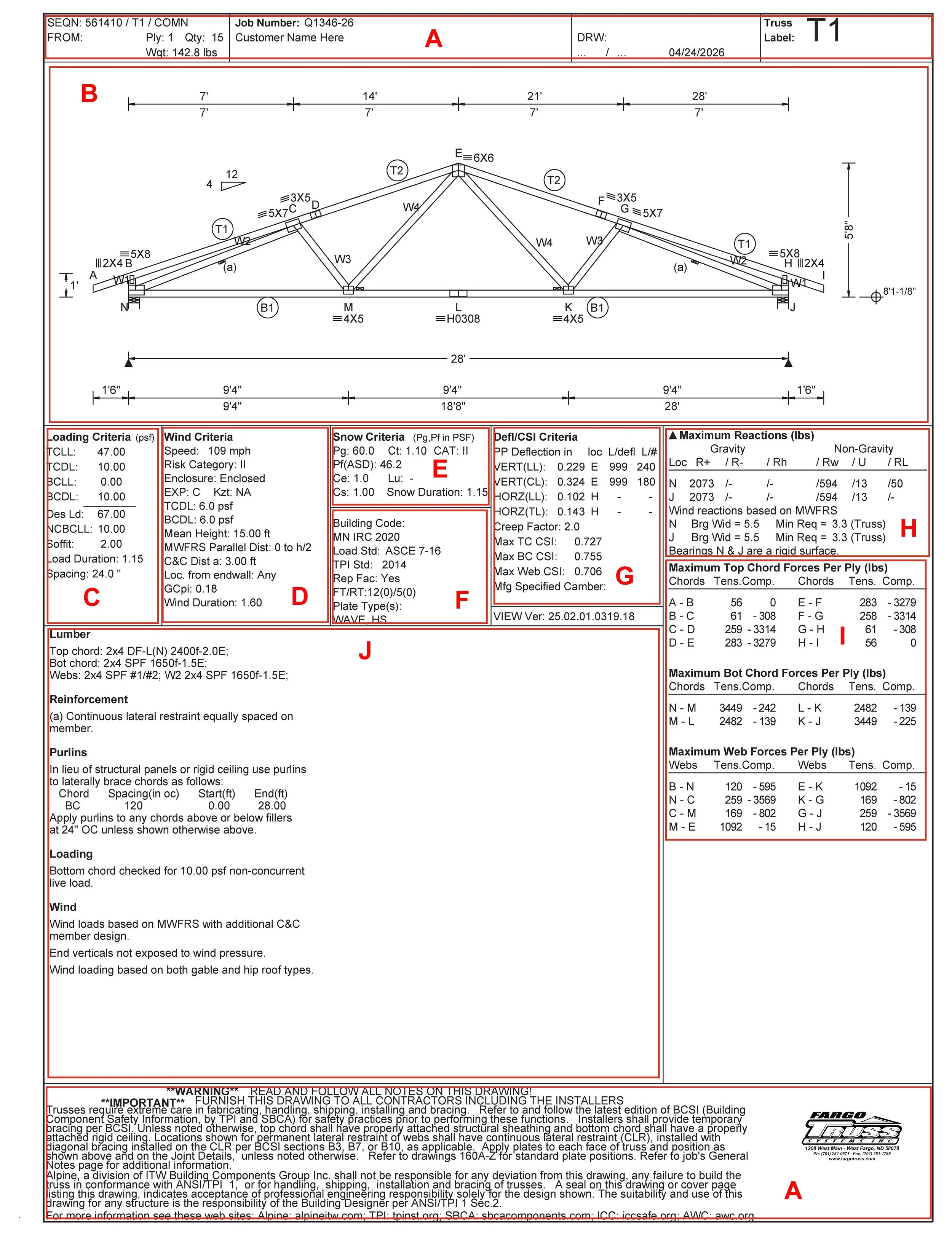
Spec Sheet Anatomy
A) Title Block
B) Diagram of Truss
C) Standard Loadings
D) Wind Loadings
E) Snow Loadings
F) Codes and Standards
G) Additional Design Criteria
H) Reactions/Load Transfers
I) Member Reactions
J) Notes Section
Box(es) A - The Title Block
It sounds boring because it is, objectively, some of the most boring rectangles ever drawn by a human being. But it's also useful edges of the page. Job name, truss designation/name, span, pitch, and spacing can all live there, (depending on how the manufacturer has their software set) along with a date and a version number that can matter to some people. Remember, change orders happen. Make sure you're installing based off the current version, not the one from three revisions ago that someone printed, taped to a wall, and then quietly forgot existed.
Box B - The Diagram of the Truss
The drawing itself (Box B) shows the truss profile: top chords sloping up to the peak, bottom chord running flat, and a web of interior members holding the whole thing together like a very committed group project. Each member gets labeled with a size and grade (Noted in Box J), something like 2x4 SPF No.2, which tells you exactly what lumber the engineering assumed. Swap that lumber for something else because it was closer to the table, and you've quietly invalidated the engineering. Even if the new piece looks close enough to fool absolutely everyone, chances are that it will not fool physics.
Panel points are where things get interesting, sort of how like you favorite horror film made the killer the victims long lost twin sibling. These are the spots where webs meet the chords, marked with plate sizes, usually something like 3x5 or 4x6. Those numbers refer to the metal connector plates holding the joint together, and they are not arbitrary, despite looking like someone picked them out of a hat. A bigger plate means the engineering calculated more force running through that joint than through its neighbors, who frankly aren't carrying their weight.
Box C - Standard/Design Loadings
Standard/Design Loadings live in Box C. Here you will be given useful information about the loading the truss was designed for as well as the on center spacing. Think of Top Chord Live Load (TCLL) as your temporary load (snow, roofers, construction materials, etc). Top Chord Dead Load (TDLL) are permanent loads (shingles, sheathing, etc). The same holds true for your bottom chord (BCLL/BCDL). These should be verified by the building designer, owner, or entity having jurisdiction over the building site. Remember, a truss engineered for a light shingle roof isn't the same as one engineered to carry a heavier tile roof, even if the two look like structural twins from across the room; just like twins, one will react poorly if one gains unexpected weight.
Box D - Wind Loadings
The wind criteria the truss was designed for is in this box. Here you will find the design speed the truss software has accounted for, the risk category, the exposure factor as well as all the other wind information that will tell a reputable building designer whether or not Dorothy and her little dog can take shelter in the structure. This information may also be helpful to the owner and entity having jurisdiction of the building site.
Box E - Snow Loadings
Here is an important box for those of us who like to live where the wind hurts our faces 6 months out of the year. This box shows the snow loading that the truss was designed for. Here, the building designer or owner of the structure can verify that the Thermal Factor (Ct), the Exposure Factor (Ce) and the Ground Snow Load (Pg) meet their requirements and local code requirements.
Box F - Codes and Standards
If you are wondering what building code iteration, ASCE (American Society of Civil Engineers) standard or TPI (Truss Plate Institute) standard was used to design your truss, here is the place to find it.
Box G - Additional Design Criteria
If you are looking for your deflection , creep factor, or specified camber, you will find it here.
Box H - Reactions/Load Transfers
Some important information lives in this box. If you ever find yourself wondering what the maximum weight of a fully loaded truss would transfer to the bearing member, you will find it here. This is also where you will find the current designed bearing width as well as the minimum required bearing width the truss needs to function.
Box I - Member Reactions
This box should only be looked at by an Engineer or someone nerdy enough to know what all these are for, so I will save an in-depth explanation, as this is not a collegiate level course.
Box J - Notes Section
This box is meant to be an area where either the design software can place notes of some significance or the truss designer can place notes they deem of some importance. You will find notes here when something either cannot fit somewhere else, or something is “out of the norm” for this truss.
Conclusion
The majority of people will never need to know even half of what are on these sheets, but with a little guidance you won’t be wondering why “Duration Factor” sounds like something from a workout app (it is not).
None of this requires an engineering degree, a decoder ring (keep checking your cereal boxes though), or a strongly worded phone call to your supplier. What solves the majority of peoples questions is just taking a second look at what might have been overlooked on a sheet that contains a lot of information.
Fargo Truss Systems designs and manufactures engineered roof and floor trusses for residential and commercial projects across the region. These posts are informational only. No liability is assumed by poster, or any party associated with the poster or writer of this blog post.